
There is a fairly established way of using a high-end drum scanner.
Mount the film properly. Use mounting fluid. Keep everything perfectly flat. Extract as much resolution, sharpness and tonal information from the film as the scanner can possibly deliver.
That is normally exactly what we want.
But photography is not always about extracting the maximum amount of information.
Sometimes a photograph simply looks better when you don’t.

These photographs came from a small experiment with Kodak E100 slide film, shot on a Nikon F5 during an elopement near the Cinque Terre in Italy.
Haley and Daniel had travelled from the United States to elope in Italy. I was photographing their day digitally, but I also had the F5 with me and a roll of E100.
So every now and then I picked up the film camera.
There was no complicated plan behind it. It was simply another way of looking at the same afternoon.
And later, when it came time to scan the transparencies, I decided to experiment again.
Scanning Kodak E100 without wet mounting
These scans were made on our Heidelberg Tango drum scanner, but there is one important difference from our normal scanning process.
The film was scanned dry rather than wet mounted.
Technically, this is not how the Tango is intended to produce its best possible scan. Wet mounting is used for good reasons. It helps keep the film optically coupled to the drum, reduces the visibility of surface imperfections and allows the scanner to extract an extremely clean and detailed image.
Normally, that is exactly the approach we use.
This time I deliberately didn’t.
Why?
Because I wanted to see what happened if I treated the scanner less like a measurement instrument and more like another part of the photographic process.
And something interesting happened.
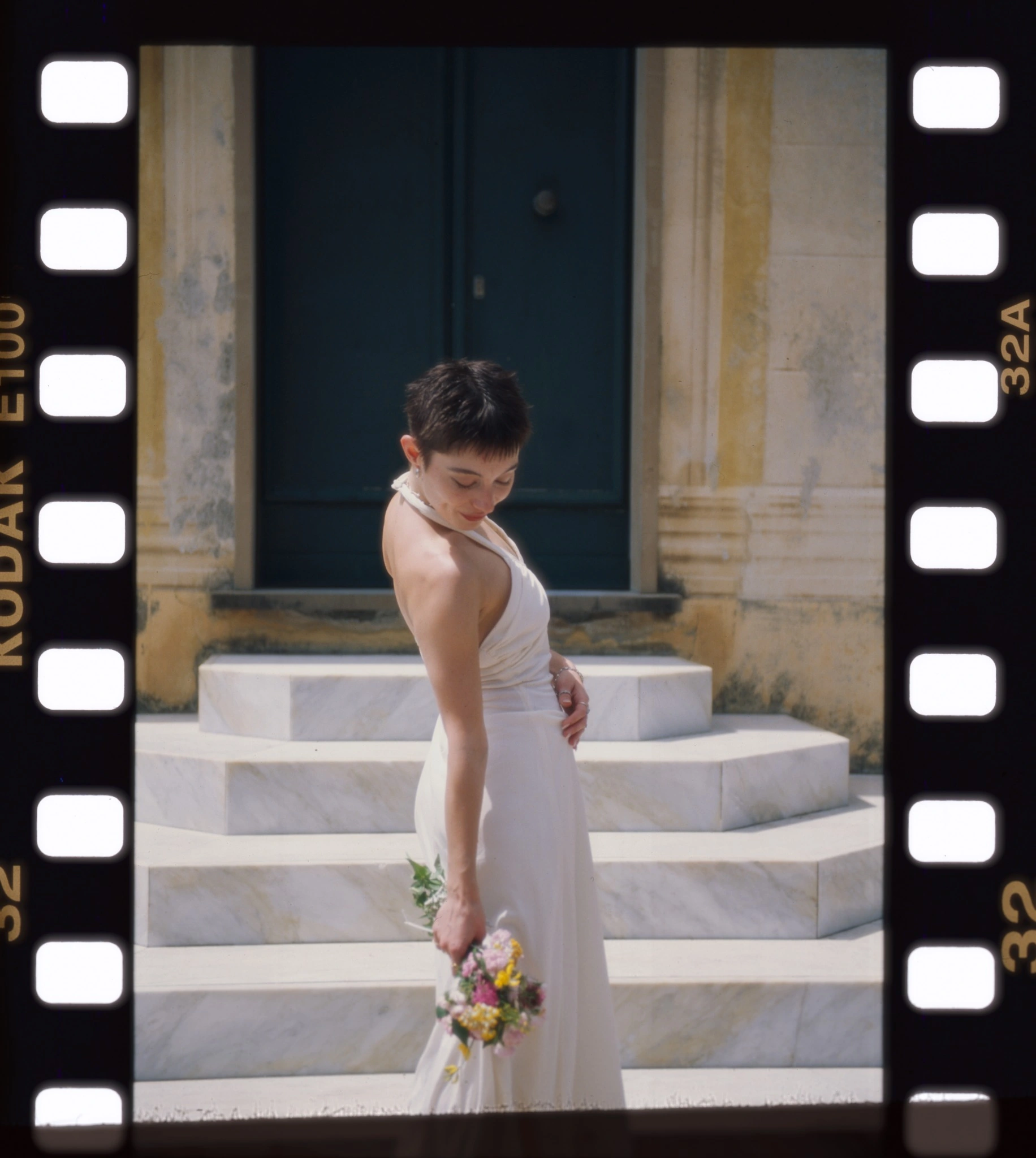
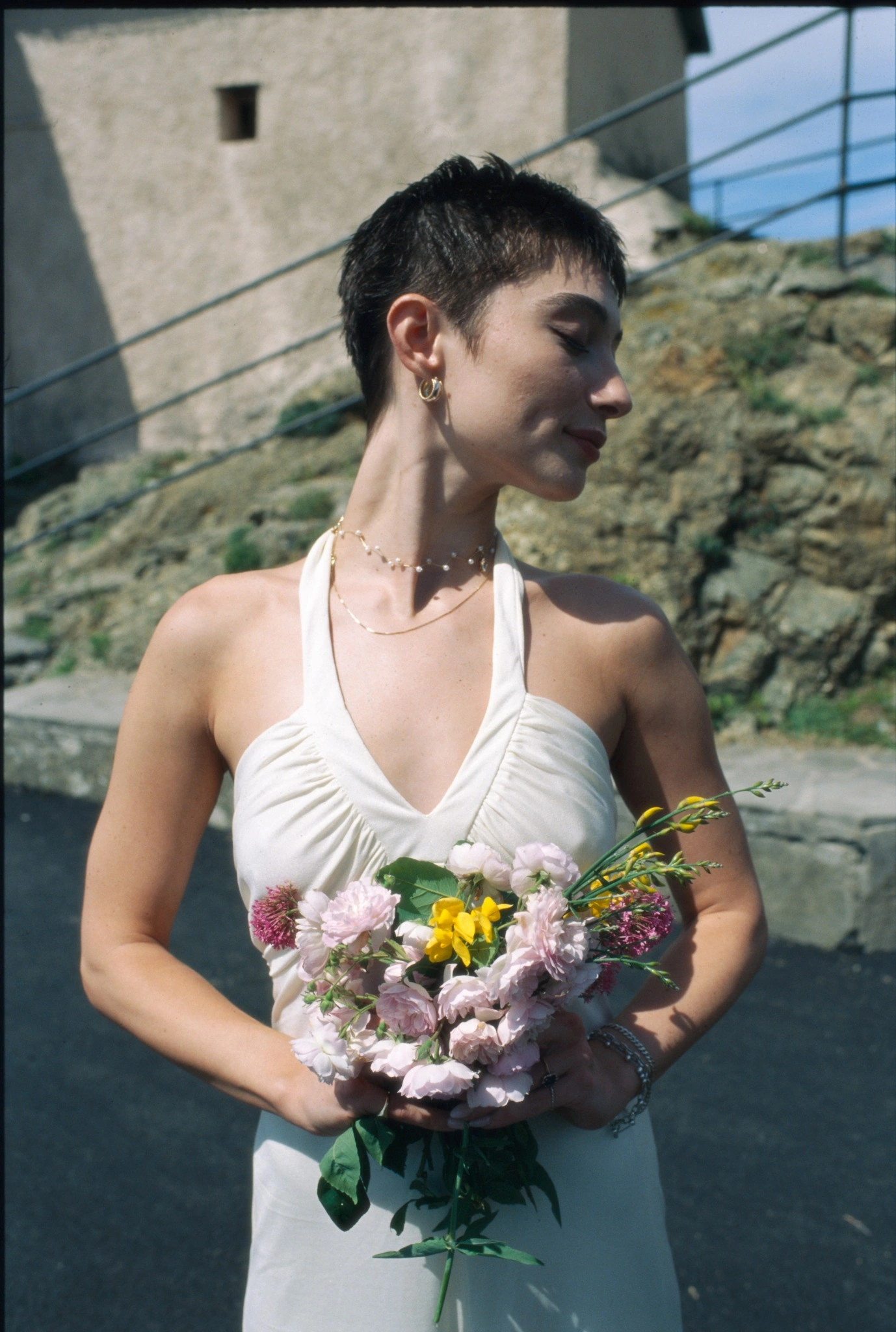
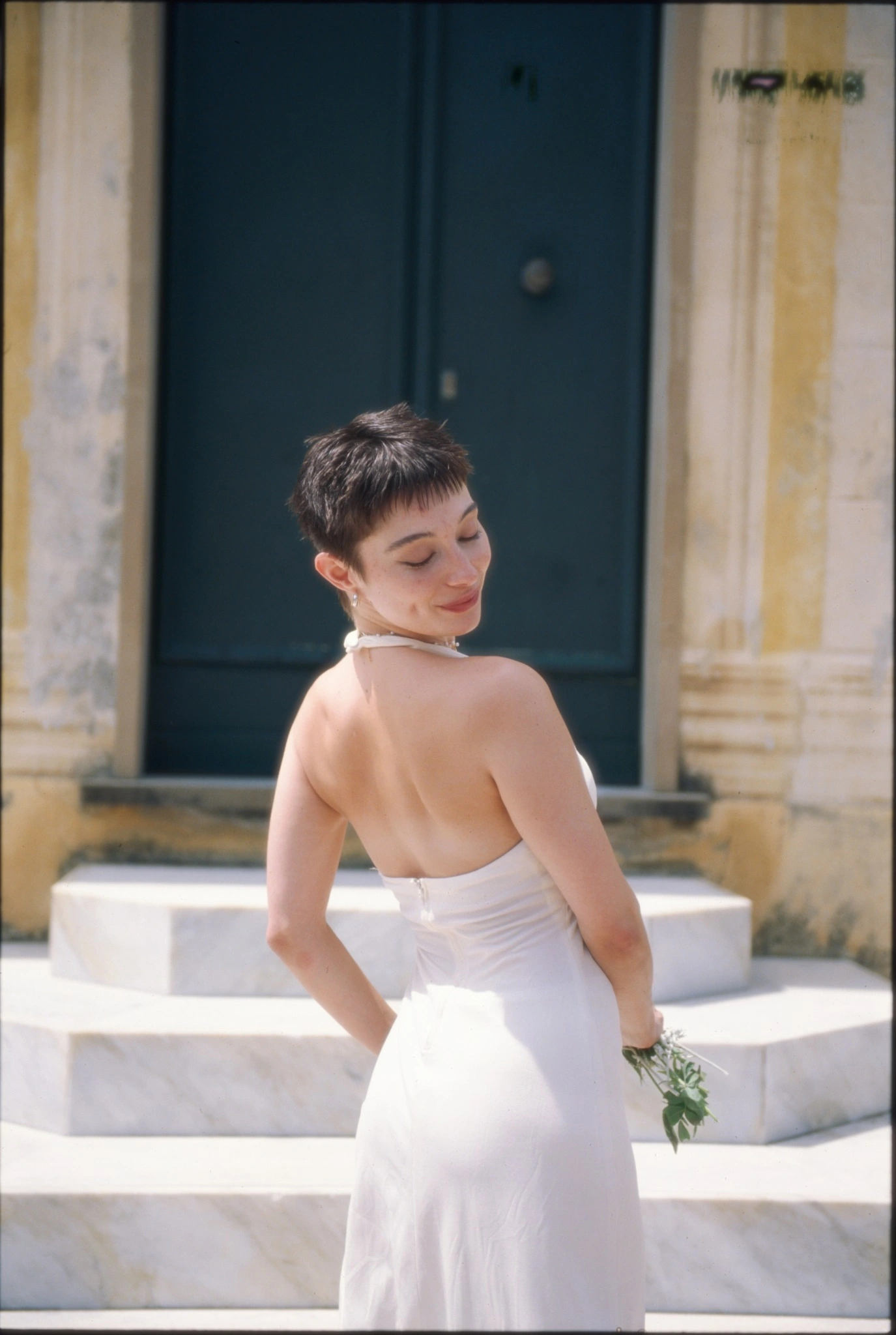
The dry scans became slightly softer.
Around very bright, high-contrast areas there is also a subtle glow. Fine detail is still there, but it doesn’t have quite the same hard separation as a perfectly wet-mounted drum scan.
Technically, you could describe some of this as imperfection.
Photographically, I rather like it.
Kodak E100 in Italian sunlight
E100 is not a particularly forgiving film, especially in strong sunlight. Slide film gives you much less latitude than colour negative film, and you can see that quite clearly on this roll.
Some of the frames near the church are more heavily exposed than others. The white dress and marble steps push right towards the limit, and in places the highlights become very bright.
I actually like seeing that variation across the contact sheet because it shows the reality of shooting slide film rather than presenting it as something clinically perfect.
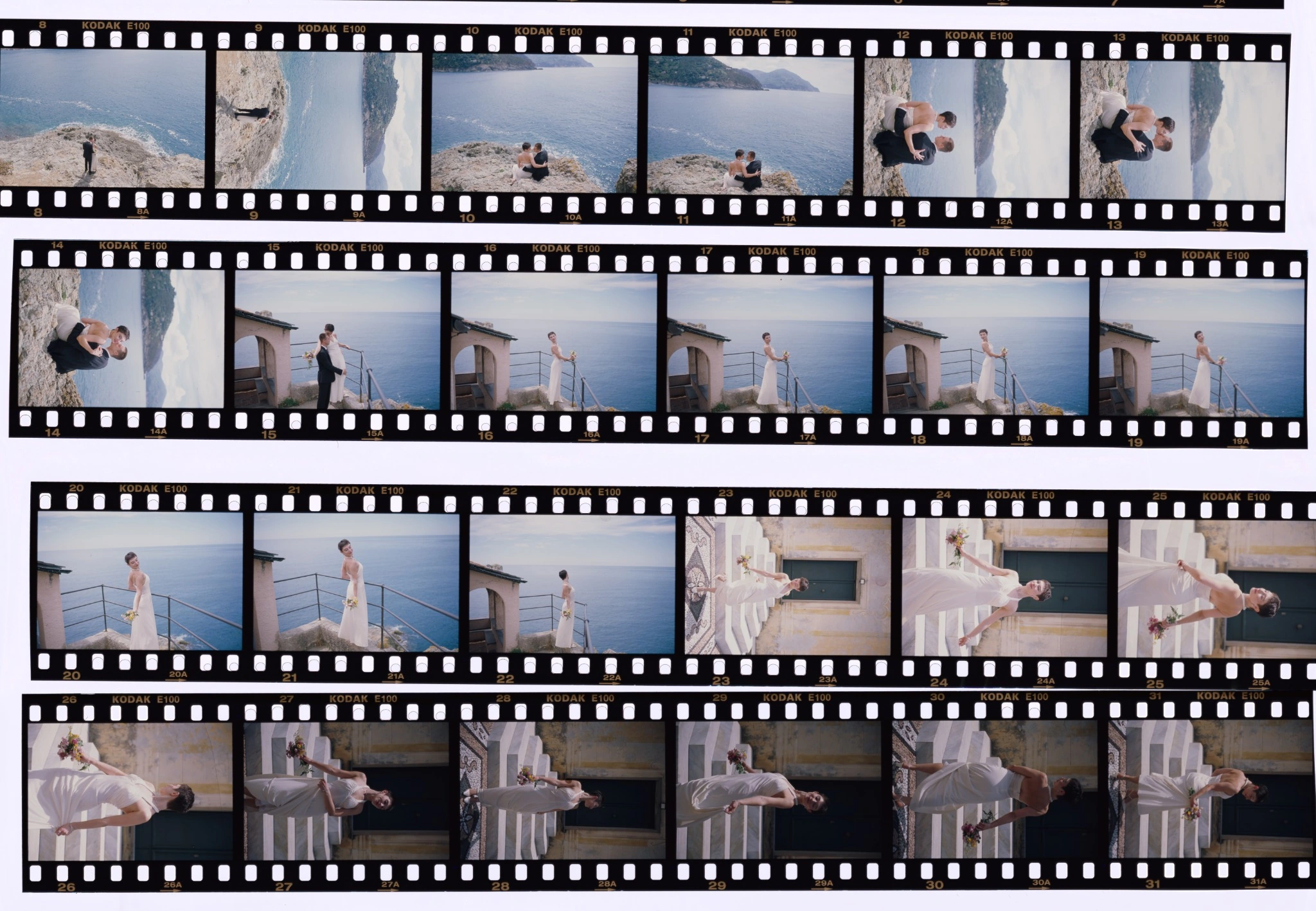
The exposures by the sea are more restrained, while the church photographs have a brighter, almost glowing quality.
When those transparencies were then scanned dry on the Tango, that softness and glow became even more noticeable. Instead of trying to correct everything back towards technical perfection, I decided to keep it.
That is really the point of this experiment.
I was not trying to produce the sharpest or most technically exact scan possible. I was trying to make a scan that suited the photograph.

When scanning becomes interpretation
Normally, scanning slide film is a fairly precise exercise.
With a transparency such as Kodak E100, the colour is already there. You can hold the film up to the light and see the finished positive image. The job of the scanner is largely to reproduce that transparency as faithfully as possible, preserving its colour, density, highlight detail and tonal relationships.
Negative film is different.
A colour negative has to be inverted and interpreted. Decisions about colour balance, contrast, density and the overall look are part of the conversion. Two people can scan the same negative and produce noticeably different photographs, even when both scans are technically good.
Slide film usually leaves much less room for that kind of interpretation.
That is partly why this experiment interested me.
By scanning these E100 transparencies dry rather than wet mounting them, I deliberately introduced something that was not present in the usual precision-focused workflow. The result was slightly softer, with a subtle glow around some of the brighter and higher-contrast areas.
I was no longer simply asking the Tango to reproduce the transparency with maximum technical accuracy.
I was allowing the scanning method itself to influence the photograph.
For archival reproduction, that would normally be the wrong approach. For these portraits, I liked what it did.
And because I am looking at these photographs primarily as a photographer rather than as a scanner technician, that distinction matters to me.
Technically, this is not a perfect scanning process. Funny enough, a friend of mine once owned an advertising agency called “Not Perfect”, and that name feels surprisingly appropriate here.

A photographer looking at a scanner
This is probably where my perspective differs slightly from that of a scanner technician.
I am a photographer first.
When I look at a scan, the first question in my head isn’t necessarily:
How much resolution did we extract?
It is:
Does the photograph feel right?
For archival work, reproduction or artwork digitisation, maximum fidelity can be absolutely critical. You want the scanner to disappear and reproduce what is on the film as faithfully as possible.
Portrait photography can be different.
Skin doesn’t always need another degree of microscopic sharpness. A white wedding dress in bright Italian sun doesn’t necessarily need every transition to be brutally defined.
Sometimes a little softness helps.
The slight diffusion in these scans fits the photographs surprisingly well. The highlights breathe a little. The bright Mediterranean light feels almost luminous. The images retain the unmistakable colour and transparency of E100, but they lose a little of the hard technical precision we usually associate with a drum scan.
And for photographs of people, I think that can be beautiful.


There is no single perfect scan
This doesn’t mean we are suddenly going to dry scan every transparency that comes through the studio.
Far from it.
Wet-mounted drum scanning remains the right method when the aim is maximum sharpness, tonal separation and faithful reproduction of the original film.
But there is something useful in occasionally breaking your normal process.
A scanner as capable as the Heidelberg Tango can reveal an astonishing amount of information from film.
The interesting question is whether every photograph actually needs all of it.
Sometimes the technically superior version is also the photographically superior version.
Sometimes it isn’t.
With these photographs of Haley and Daniel in Italy, I prefer the softer interpretation.
The tiny glow around the highlights, the gentler detail and the slightly imperfect rendering feel appropriate to the subject.
Perhaps that is the important distinction.
We are not scanning resolution charts.
We are scanning photographs.
And photographs are allowed to have a little atmosphere.
If you want to see the opposite approach, compare these with our wet-mounted Kodak E100 drum scans. Those files were scanned at approximately 4000 × 6000px in 16-bit Lab and shown with no post-scan colour correction.
Photographs: Janis Ratnieks
Camera: Nikon F5
Film: Kodak E100
Scanner: Heidelberg Tango drum scanner
Scanning: wescan.film
Location: Liguria, Italy / Cinque Terre area


